Himalaya only · Saver trips from ₹7,500

Himalaya HivesKashmir to Arunachal

India · First-flush olive and toy-train blue

Darjeeling & Kalimpong

Tea slopes, toy trains and Lepcha hills

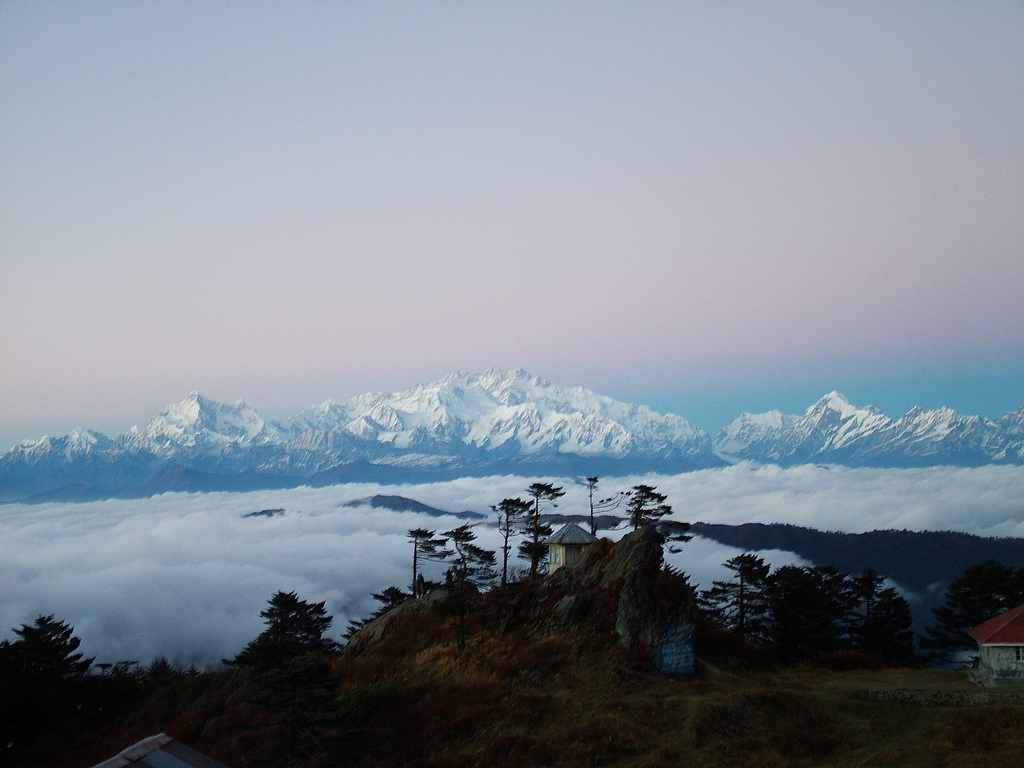
Darjeeling and Kalimpong are the West Bengal hills between Nepal, Sikkim and Bhutan, 1,200 to 3,636 m high. Go March to May or October to November for clear views of Kangchenjunga. Plan 5 to 7 nights: Darjeeling for tea and the toy train, Kalimpong for nurseries and monasteries, Sandakphu for the high ridge.

Best months
Mar – May · Oct – Nov
Altitude
1,200–3,636 m
Saver from
₹9,500
Signature from
₹1,10,000
Darjeeling & KalimpongPhoto: Arne Hückelheim 2010-09-21 12:41:53 This is a … · CC BY-SA 4.0 · Commons

The Darjeeling hills are a short climb from the plains. New Jalpaiguri station sits at about 100 m; three hours of hairpins later you are at 2,045 m on the Darjeeling ridge, with Kangchenjunga 74 km to the north. In between lie Kurseong, the tea gardens of the Kurseong and Darjeeling slopes, and the orange villages of the Riyang valley. East of the Teesta river, Kalimpong sits on its own ridge at 1,250 m, with Lava and Rishyap higher up in the forests that run into Neora Valley National Park.

This is a small hive with a long memory. The Lepcha people lived here before anyone drew a border. Bhutan held Kalimpong until 1865, Sikkim leased the Darjeeling ridge to the East India Company in 1835, and labourers from Nepal built the tea gardens, the roads and the railway. Today Nepali is the common language, Tibetan monasteries share ridges with Hindu temples and Scottish mission churches, and the tea is protected by India's first geographical indication.

We plan this hive for three kinds of trip. The saver trip uses overnight trains from Kolkata, shared jeeps from New Jalpaiguri, and government lodges or homestays, and it is honestly cheap: a long weekend can cost under ₹10,000 per person on the ground. The comfort trip uses a private car, a tea-country hotel and village homestays. The signature trip stays at Windamere, Glenburn and Taj Chia Kutir, with a private guide.

Timing matters more here than almost anywhere in the Himalaya. The monsoon, June to September, brings most of Darjeeling's 3,100 mm of annual rain and regular landslides on the roads. October and November give the clearest mountain views. March to May brings first flush tea and rhododendrons on the Singalila Ridge, with more haze. Winter is cold, dry and quiet, and the best time for Sittong's oranges.

The Lepcha ridge of the thunderbolt

Before the British arrived, the ridge belonged to Lepcha and Limbu communities who farmed and hunted in thick forest. The Lepcha call themselves Rongkup, the children of the Rong, and have their own language and script. Wikipedia's Darjeeling article records that Lepcha inhabitants knew the ridge as Dorje-ling, the place of the thunderbolt, and many local names still carry Lepcha roots: Kurseong may come from kurson-rip, a small white orchid, Mirik from mir-yok, a place burnt by fire, and Sandakphu means the height of the poisonous plant. Through the 18th century the hills passed between Sikkim, Nepal and Bhutan. Kalimpong was under Bhutan from about 1706, and a Lepcha chief, Gyabo Achuk, held the fort at Damsang near Pedong until Bhutanese forces took the area.

A lease, a sanatorium and a tea bush

In 1829 two Company officers crossing the hills saw the crescent ridge as a place for British officials to escape the heat of Calcutta. In 1835 the East India Company leased a strip about 40 by 10 km from the Chogyal of Sikkim. Archibald Campbell, a physician made superintendent in 1839, began planting Chinese tea seed around 1841. The first Company experimental gardens, at Tukvar, Steinthal and Alubari, followed in 1852, and Happy Valley in 1854. By 1870 there were 56 gardens and some 8,000 labourers, most of them recruited from Nepal. They spoke Nepali with each other, and from their languages, customs and shared work grew the Indian Gorkha identity that defines these hills today.

Two feet of track to the clouds

Until 1878 the journey from Calcutta took five or six days by train, ferry, bullock cart and palanquin. Then the railway reached Siliguri, and in 1879 work began on a 2 ft gauge line up the Hill Cart Road. It reached Darjeeling on 4 July 1881, climbing from about 100 m to over 2,200 m with loops and zig-zags instead of a rack. The Batasia Loop, below Ghum, was added in 1919. The Darjeeling Himalayan Railway carried tea down and summer residents up, survived earthquakes, landslides and an 18-month closure in 1988 and 1989, and in 1999 UNESCO declared it a World Heritage Site. The steam engines still running are B-Class tanks built between 1889 and 1925.

Kalimpong, wool and the road to Lhasa

After the Anglo-Bhutan War, the Treaty of Sinchula in 1865 gave the British the hills east of the Teesta. Kalimpong was then a hamlet of two or three families. Its position on the mule route over the Jelep La to the Chumbi Valley and Lhasa turned it into a trading post for wool, furs and grain, and Tibetan, Bhutanese, Marwari and Nepali traders settled along its ridge. Scottish missionaries opened schools; Dr Graham's Homes started in 1900 with six children. The Jelep La closed after the 1962 war and the trade ended, but monks who came from Tibet after 1959 built monasteries, and Kalimpong's growers turned to flowers. Its nurseries still ship orchids, bulbs and cacti across India.

Why go

Six reasons Darjeeling & Kalimpong is worth the climb

Ride the toy train to Ghum and Batasia

The Darjeeling Himalayan Railway, a UNESCO World Heritage Site since 1999, still runs 2 ft gauge trains along the Hill Cart Road. The joy ride from Darjeeling climbs to Ghum, the summit of the line at about 2,260 m, and loops around the Batasia memorial garden. Steam rides cost more and sell out first.

Walk a working tea garden in first flush

Darjeeling tea has been a geographical indication since 2004, the first in India. From March to May the estates pluck the first flush, two leaves and a bud by hand. Happy Valley, 3 km from town, is open to visitors, and estates around Kurseong offer walks and tastings where tours run.

Watch Everest from Sandakphu

At 3,636 m, Sandakphu is the highest point in West Bengal. From the summit village you can see Everest, Lhotse, Makalu and Kangchenjunga on a clear morning. Walk up the Singalila Ridge in four days with a guide, or ride a vintage Land Rover from Manebhanjan.

Kalimpong nurseries and monasteries

Kalimpong's nurseries grow orchids, gladioli, bulbs and cacti for buyers across India. Spend a morning in the greenhouses, then climb Durpin Hill to Zang Dhok Palri Phodang, consecrated by the Dalai Lama in 1976, which keeps the 108 volumes of the Kangyur brought out of Tibet.

Sleep in a forest village above Lava

Lava, at about 2,195 m, is the gateway to Neora Valley National Park, where red pandas live in the bamboo and oak forest. Ten kilometres on, Rishyap faces the Kangchenjunga range from 2,590 m. Lepcha and Sherpa families run simple homestays with wood stoves and home cooking.

Orange season in Sittong

In the Riyang valley below Kurseong, Sittong's farmers grow Darjeeling mandarin oranges between their houses. From late November to January the trees are heavy with fruit. Stay in a homestay, walk the orchards, and visit Rabindra Bhavan at Mungpoo, where Tagore stayed between 1938 and 1940.

Inside the hive

Where to go in Darjeeling & Kalimpong

Ordered by how many of our trips stop there, with the altitude you sleep at.

DarjeelingPhoto: Arne Hückelheim 2010-09-21 12:41:53 This is a … · CC BY-SA 4.0 · Commons
2,045 m · Hill station · Darjeeling & Kalimpong

Darjeeling

The thunderbolt ridge, its tea and its two-foot railway

Best Mar – May · Oct – Nov2–3 nights
KurseongPhoto: Mayukh Ghose · CC BY-SA 4.0 · Commons
1,482 m · Hill station · Darjeeling & Kalimpong

Kurseong

The toy train's home town, ringed by old tea gardens

Best Mar – May · Oct – Dec1–2 nights
KalimpongPhoto: Bernard Gagnon · CC BY-SA 4.0 · Commons
1,250 m · Town · Darjeeling & Kalimpong

Kalimpong

Old wool-trade town of nurseries, monasteries and schools

Best Feb – May · Oct – Nov2 nights
LavaPhoto: Pinakpani · CC BY 4.0 · Commons
2,195 m · Village · Darjeeling & Kalimpong

Lava

Misty forest village at the gate of Neora Valley

Best Mar – May · Oct – Nov1–2 nights
RishyapPhoto: Pinakpani · CC BY 4.0 · Commons
2,590 m · Village · Darjeeling & Kalimpong

Rishyap

Sunrise village facing the Kangchenjunga range

Best Mar – Apr · Oct – Jan1–2 nights
Sandakphu and SingalilaPhoto: solarshakti · CC BY 2.0 · Commons
3,636 m · National park · Darjeeling & Kalimpong

Sandakphu and Singalila

West Bengal's highest point, with Everest on the skyline

Best Mar – May · Oct – Nov3–5 nights
SittongPhoto: Auli Raha (অলি রাহা) · CC BY-SA 4.0 · Commons
1,200 m · Village · Darjeeling & Kalimpong

Sittong

Orange orchards and homestays in the Riyang valley

Best Oct – Jan2 nights
Takdah and TinchuleyPhoto: Amitabha Gupta · CC BY 4.0 · Commons
1,500 m · Village · Darjeeling & Kalimpong

Takdah and Tinchuley

An old British cantonment in mist and cedar forest

Best Mar – May · Oct – Dec2 nights
LepchajagatPhoto: SubrataEmfluence · CC BY-SA 4.0 · Commons
2,100 m · Village · Darjeeling & Kalimpong

Lepchajagat

A forest hamlet on the Ghum–Mirik road

Best Mar – Apr · Oct – Jan1 nights
MirikPhoto: Benoy · CC BY-SA 3.0 · Commons
1,495 m · Lake · Darjeeling & Kalimpong

Mirik

A lake town among tea gardens on the Nepal border

Best Mar – May · Oct – Dec1 nights

Trips

Darjeeling & Kalimpong trips in three tiers

Photo: Arne Hückelheim 2010-09-21 12:41:53 This is a … · CC BY-SA 4.0 · Commons Saver
Darjeeling & Kalimpong · 3 nights · sleeps to 2,045 m

Darjeeling long weekend from Kolkata

Overnight train, shared jeeps, toy train joy ride

From, per person₹9,500Mar – May · Oct – Nov
Photo: Arne Hückelheim 2010-09-21 12:41:53 This is a … · CC BY-SA 4.0 · Commons Saver
Darjeeling & Kalimpong · 6 nights · sleeps to 2,590 m

Darjeeling, Kalimpong and Lava by shared jeep

Shared jeeps, one short reserved car

From, per person₹17,500Mar – Apr · Oct – Nov
Photo: Mayukh Ghose · CC BY-SA 4.0 · Commons Comfort
Darjeeling & Kalimpong · 5 nights · sleeps to 2,045 m

Tea and toy train: Kurseong and Darjeeling

Private car with driver

From, per person₹38,000Mar – May · Oct – Nov
Photo: Auli Raha (অলি রাহা) · CC BY-SA 4.0 · Commons Comfort
Darjeeling & Kalimpong · 7 nights · sleeps to 2,045 m

Sittong, Takdah and Kalimpong villages

Private car with driver

From, per person₹44,000Mar – Apr · Oct – Jan
Photo: Arne Hückelheim 2010-09-21 12:41:53 This is a … · CC BY-SA 4.0 · Commons Signature
Darjeeling & Kalimpong · 7 nights · sleeps to 3,636 m

Windamere, Sandakphu and Taj Chia Kutir

Private SUV with driver; reserved Land Rover on the Singalila Ridge

From, per person₹1,10,000Mar – Apr · Oct – Nov
Photo: Mayukh Ghose · CC BY-SA 4.0 · Commons Signature
Darjeeling & Kalimpong · 6 nights · sleeps to 2,045 m

Taj Chia Kutir, Windamere and Glenburn

Private SUV with driver

From, per person₹1,20,000Mar – May · Oct – Nov

What it costs

A day in Darjeeling & Kalimpong, three ways

Per person per day, indicative 2026, once you are in the hive.

Darjeeling & Kalimpong on a budget
Saver

Per person, per day₹2,000–3,500

Government lodge or homestay bed, local meals, shared jeeps between towns

Comfort

Per person, per day₹6,000–11,000

3–4 star hotel or good homestay, private car with driver, entry fees

Signature

Per person, per day₹20,000–45,000

Heritage or tea-estate luxury stay, all meals, private car and guide

Six ways to spend less in Darjeeling & Kalimpong

  • Take an overnight sleeper from Kolkata to New Jalpaiguri instead of flying to Bagdogra; a sleeper berth costs about ₹500–700 and saves a hotel night.
  • From NJP or Siliguri, a shared jeep seat to Darjeeling or Kalimpong costs about ₹250–400, against ₹3,000–4,000 for a reserved car.
  • Book the diesel toy train joy ride instead of the steam one if budget matters; it covers the same Ghum and Batasia loop for less.
  • Share a Tiger Hill jeep with other travellers from your hotel; the per-seat fare is a fraction of a private booking.
  • Eat momos, thukpa and thali in local cafes off the Mall and Chowrasta, where a full meal costs ₹150–300.
  • Visit in the shoulder weeks of early March, late November and December, when hotels in Darjeeling cut rates noticeably.

Say it like a local

Eight words for Darjeeling & Kalimpong

LepchaRongkup
children of the Rong; the Lepcha people's name for themselves
NepaliBhanjyang
a pass or saddle on a ridge, as in Manebhanjan
NepaliPokhari
pond or small lake, as in Jorepokhri and Sukhiapokhri
NepaliChhurpi
cheese made from buttermilk; the hard kind is chewed for hours
NepaliSel roti
ring-shaped fried bread of rice flour, made for Dashain and Tihar
NepaliGundruk
fermented, sun-dried leafy greens, cooked into soup or pickle
Tea trade EnglishFirst flush
the first spring plucking, March to May, light and floral
Tea trade EnglishMuscatel
the fruity, grape-like flavour of second flush Darjeeling tea

Field notes

Things few people tell you about Darjeeling & Kalimpong

All Darjeeling & Kalimpong notes
Sourced Darjeeling · 2,045 m

When the British arrived, the Lepcha people living on the ridge called it Dorje-ling, the place of the thunderbolt. The name Darjeeling comes from this Tibetan-rooted word for the vajra.

Source: Darjeeling

Sourced Darjeeling · 2,045 m

In 1835 the East India Company leased a strip of land about 40 km by 10 km from the Chogyal of Sikkim to build a sanatorium. In 1849 the British annexed some 1,700 sq km more.

Source: Darjeeling

Sourced Darjeeling · 2,045 m

Happy Valley Tea Estate, 3 km from town, was established in 1854. It is Darjeeling's second oldest estate after Steinthal (1852), and its factory at about 2,100 m is among the highest tea factories in the world.

Source: Happy Valley Tea Estate

Sourced Kalimpong · 1,250 m

According to K.P. Tamsang, writing on Lepcha history, the name Kalimpong comes from the Lepcha Kalenpung, meaning hillock of assemblage, later corrupted to Kalebung and Kalimpong.

Source: Kalimpong

Sourced Kalimpong · 1,250 m

When Bhutan ceded the land east of the Teesta under the 1865 Treaty of Sinchula, Kalimpong was a hamlet with only two or three families. Its position near the Jelep La turned it into a trading post for wool, furs and grain.

Source: Kalimpong

Sourced Kalimpong · 1,250 m

John Anderson Graham opened St Andrew's Colonial Homes on 24 September 1900 below Deolo hill, in a rented cottage with six children. By the 1920s it housed 600 children. It was renamed Dr Graham's Homes in 1947.

Source: Dr. Graham's Homes

Map of Darjeeling, Kalimpong, Kurseong, Lava, Lepchajagat, Mirik, Rishyap, Sandakphu and Singalila, Sittong, Takdah and TinchuleyIndiaChinaBhutanBangladeshNepalDarjeeling1Kalimpong2Kurseong3Lava4Lepchajagat5Mirik6Rishyap7Sandakphu and Singalila8Sittong9Takdah and Tinchuley1050 kmN
  1. 1Darjeeling
  2. 2Kalimpong
  3. 3Kurseong
  4. 4Lava
  5. 5Lepchajagat
  6. 6Mirik
  7. 7Rishyap
  8. 8Sandakphu and Singalila
  9. 9Sittong
  10. 10Takdah and Tinchuley
Drawn by Himalaya Hives from Natural Earth outlines (public domain). Borders as depicted by India. Not for navigation.

Experiences

Days worth planning around

Photo: Souviksen · CC BY-SA 4.0 · Commons
Darjeeling · 2 hours

Toy train joy ride to Ghum and Batasia Loop

A 2-hour round trip on the 2 ft gauge Darjeeling Himalayan Railway, climbing from Darjeeling to Ghum station at about 2…

₹1,000 diesel; ₹1,500–1,700 steam (indicative)
Photo: Sumit Surai · CC BY-SA 4.0 · Commons
Kalimpong · 2–3 hours

Kalimpong cactus and orchid nursery visit

Tour two or three of Kalimpong's family-run nurseries, which grow cacti, succulents, orchids, gladioli and bulbs for bu…

Free–₹50 per nursery; car ₹1,000–1,500
Photo: Pinakpani · CC BY 4.0 · Commons
Kurseong · 2 hours

Kurseong station, DHR museum and bazaar walk

Walk the heart of the Darjeeling Himalayan Railway in its headquarters town: the dead-end station with its one-room mus…

Museum ₹20–50; free to walk
Photo: Sandipanjalpaiguri · CC BY-SA 4.0 · Commons
Lava · Full day

Neora Valley National Park forest day

Enter Neora Valley National Park from Lava with a forest permit and guide for a day in one of eastern India's least dis…

Entry, vehicle and guide ₹1,500–3,500 per group (indicative)
Photo: YUVRAJ ANAND · CC BY-SA 4.0 · Commons
Lepchajagat · 2 hours

Dawn forest walk and Kangchenjunga view

Leave your Lepchajagat homestay before dawn and walk through pine and cryptomeria forest to a clearing facing Kangchenj…

Free; host-guide ₹500–800
Photo: Benoy · CC BY-SA 3.0 · Commons
Mirik · 1.5 hours

Morning walk around Sumendu Lake

Walk the 3.5 km road around Mirik's Sumendu Lake at first light, through pine woods and past the Savitri Pushpaudyan ga…

Free; boat ₹100–300
Photo: Jejsiguoa · CC BY-SA 4.0 · Commons
Rishyap · 2 hours

Tiffindara sunrise over the Kangchenjunga range

Walk about 1 km from Rishyap in the dark to Tiffindara viewpoint and watch the first light reach the Kangchenjunga rang…

Free
Photo: Alexkom000 · CC BY 4.0 · Commons
Sandakphu and Singalila · 2 hours

Sunrise on Everest and the Sleeping Buddha

Wake before dawn on Sandakphu, the highest point in West Bengal, and watch first light reach Kangchenjunga's Sleeping B…

Included in stay; park fees apply

Where to sleep

Homestays to the best lodges

All stays
Photo: Pinakpani · CC BY 4.0 · Commons Budget
Government tourist bungalow · Lava

WBFDC Lava Eco Tourism Centre

Forest cottages run by the West Bengal Forest Development Corporation among tall pines near Lava bazaar, at about …

₹1,000–3,000 a night for a cottage or double (indicative)
Photo: Subhrajyoti07 · CC BY-SA 4.0 · Commons Budget
Government tourist bungalow · Darjeeling

Meghbalika Tourism Property (WBTDC)

The West Bengal Tourism Development Corporation's lodge in Darjeeling town, formerly the Darjeeling Tourist Lodge.…

₹2,000–4,500 a night for a double (indicative)
Photo: Mayukh Ghose · CC BY-SA 4.0 · Commons Budget
Government tourist bungalow · Kurseong

Roudra Chhaya Tourism Property (WBTDC)

WBTDC's lodge in Kurseong, formerly the Kurseong Tourist Lodge, with standard and larger double rooms, a restauran…

₹2,000–4,000 a night for a double (indicative)
Photo: Subhrajyoti07 · CC BY-SA 4.0 · Commons Mid
Heritage hotel · Kalimpong

Morgan House, Kalimpong (WBTDC)

A 1930s stone mansion built by the jute businessman George Morgan on Durpin Hill, now a WBTDC heritage lodge with …

₹3,000–7,000 a night for a double (indicative)
Photo: Rangan Datta Wiki · CC BY-SA 4.0 · Commons Mid
Boutique hotel · Kurseong

Cochrane Place

A restored colonial house above Kurseong, once the home of a British magistrate, run as a small boutique hotel wit…

₹6,000–12,000 a night for a double (indicative)
Photo: Arne Hückelheim 2010-09-21 12:41:53 This is a … · CC BY-SA 4.0 · Commons Mid
Guesthouse · Darjeeling

Dekeling Hotel

A long-running family hotel run by a Tibetan family on Gandhi Road, a few minutes below Chowrasta, with simple, wa…

₹3,000–6,000 a night for a double (indicative)
Photo: Arne Hückelheim 2010-09-21 12:41:53 This is a … · CC BY-SA 4.0 · Commons Luxury
Heritage hotel · Darjeeling

Windamere Hotel

A colonial hotel on Observatory Hill above Chowrasta, built in 1841 as Ada Villa, later a boarding house for tea p…

₹15,000–30,000 a night for a double (indicative)
Photo: A. J. T. Johnsingh, WWF-India and NCF · CC BY-SA 4.0 · Commons Luxury
Tea estate bungalow · Darjeeling

Glenburn Tea Estate & Boutique Hotel

Planter's bungalows inside a working tea estate founded in 1859, on slopes above the Rangeet river about 1.5 hours…

₹35,000–70,000 a night for a double, usually all-inclusive …
Photo: Mayukh Ghose · CC BY-SA 4.0 · Commons Luxury
Resort · Kurseong

Taj Chia Kutir Resort & Spa

A Taj resort set within the Makaibari tea estate near Kurseong, with rooms and suites facing the tea slopes, a Jiv…

₹20,000–45,000 a night for a double (indicative)

Questions

Darjeeling & Kalimpong, answered

How much does a Darjeeling trip cost per person?

A saver trip costs about ₹2,000–3,500 per person per day for a government lodge or homestay, local meals and shared jeeps; a 3-night Kolkata long weekend is about ₹9,500 on the ground plus the train. Comfort trips with a private car and good hotel cost ₹6,000–11,000 a day. Signature stays at Windamere, Glenburn or Taj Chia Kutir run ₹20,000–45,000 a day. All figures are indicative 2026 and per person, twin sharing.

What is the best time to visit Darjeeling and Kalimpong?

October and November give the clearest mountain views, dry weather and festival colour. March to May is the second window, with first flush tea and rhododendrons on the Singalila Ridge, but more haze and bigger crowds in May. December and January are cold and clear. Avoid July and August, when heavy rain and landslides close roads and hide the mountains.

Do I need a permit for Darjeeling, Kalimpong or Sandakphu?

Indian citizens need no permit for Darjeeling, Kurseong, Mirik, Kalimpong, Lava or Rishyap. Foreigners need no special permit either but should carry passports. Sandakphu lies in Singalila National Park, which charges a daily entry fee and requires a registered guide. Neora Valley needs a park permit from Lava. Rules and fees change, so check current status before you travel.

How do I reach Darjeeling from Kolkata cheaply?

Take an overnight train from Sealdah or Howrah to New Jalpaiguri; a sleeper berth costs about ₹500–700 and 3AC about ₹1,300–1,800. From NJP, a shared jeep seat to Darjeeling costs about ₹250–400 and takes 3–3.5 hours. Book trains 60 days ahead for holiday weekends. The return works the same way, leaving Darjeeling by 1 pm to catch an evening train.

Is Darjeeling safe for solo women travellers?

Darjeeling and Kalimpong are generally considered safe for solo women, and many travel here alone. Shared jeeps are routine and drivers are used to tourists. Use normal care: avoid isolated paths after dark, book homestays through known operators, and share your plans when trekking. On the Sandakphu trek a registered guide is compulsory anyway. Local emergency number is 112.

Is the toy train worth it and how do I book?

For most visitors the 2-hour joy ride from Darjeeling to Ghum and back, via the Batasia Loop, is the best way to experience the Darjeeling Himalayan Railway. Diesel rides cost about ₹1,000 and steam rides about ₹1,500–1,700 per person. Book on IRCTC; seats open in advance and steam trains sell out in season. Timetables change, so check current status before you travel.

Will I get altitude sickness in Darjeeling?

Most people do not. Darjeeling is at about 2,045 m and Kalimpong at 1,250 m, below the height where altitude sickness is common. Sandakphu, at 3,636 m, is different: sleeping above 3,000 m can cause headache and breathlessness, so climb slowly over several days, drink water and descend if symptoms worsen. If you have heart or lung conditions, talk to your doctor before the trek.

Are there ATMs and mobile networks in the hills?

Darjeeling, Kurseong, Mirik and Kalimpong all have ATMs and good 4G coverage on major networks. Lava has limited ATMs; carry cash for Rishyap, Sittong, Takdah and Lepchajagat, where homestays often prefer cash or UPI. On the Sandakphu trek, network is patchy and sometimes Nepali networks are stronger than Indian ones. Carry enough cash for the whole trek.

Is Darjeeling good for families with kids and seniors?

Yes, with planning. Darjeeling town is steep and walking between the Mall, hotels and sights involves stairs, so seniors should stay near Chowrasta or use taxis. The toy train joy ride, the zoo and the tea gardens suit children. Kalimpong and Mirik are gentler. Avoid the Sandakphu trek for small children and those with heart conditions; the Land Rover ride is an alternative.

Plan with a local planner

Plan Darjeeling & Kalimpong with a local planner

We reply within one working day with a route, a sleeping-altitude profile and an itemised price in your tier. Change anything. Pay nothing until you are sure.

No payment to start
Written, itemised quote
One planner, on WhatsApp
Altitude-safe pacing

Start with four details

Within one working day. No payment to start.

We reply by email or WhatsApp. See our privacy policy.

Plan Darjeeling & Kalimpong