Before the Lateral Road was built, the only route between eastern and western Bhutan passed through the courtyard of Trongsa Dzong, and on the penlop's command its gates could be shut to divide the country in two.
Source: Trongsa
Himalaya only · Saver trips from ₹7,500
Try "Spiti", "snow leopard", "Char Dham", "homestay", "Tiger's Nest"
Town in Bhutan
The dzong that could shut its gates and split the country
Trongsa is a small town at about 2,200 m on a spur above the Mangde Chhu gorge, at the geographic centre of Bhutan. Its dzong, Bhutan's largest by some counts, once controlled all east–west traffic and was the seat of the Wangchuck penlops before they became kings. One night is enough.
 Photo: Thomas Wanhoff · CC BY-SA 2.0 · Commons
Trongsa means 'new village'. A Drukpa lama, Ngagi Wangchuk, built a meditation room here in 1543 after seeing a light on the tip of the spur; his great-grandson, the Zhabdrung, raised the first dzong in 1647. It was enlarged through the 18th century and is now one of the largest dzongs in Bhutan, with around 200 monks and the district offices. The drop below it to the Mangde Chhu often disappears into cloud.
Location was everything. Until the Lateral Road arrived around 1970, the only track between western and eastern Bhutan passed through the dzong's courtyard, and its gates could be shut on the penlop's command. From here the Wangchuck penlops grew powerful enough to unify the country; since 1907 every crown prince has first held the title of Trongsa Penlop. The third king, Jigme Dorji Wangchuck, was born in a small palace near the town in 1928.
Above the dzong, the round Ta Dzong watchtower now houses a museum of the monarchy and Buddhist art. The town itself is one street of shops and simple hotels, with a vegetable market and views across the gorge. Most travellers stop here for one night between Phobjikha and Bumthang, visiting Chendebji Chorten on the way in from Pele La.
Chökhor Rabtentse Dzong rises in tiers down a rocky spur above the Mangde Chhu. It holds around 200 monks and a printing house for religious texts. Its tshechu, in December, ends with a thongdrel at dawn.
The watchtower above the dzong was built to guard it and now houses a museum with a chapel dedicated to Jigme Namgyal, Trongsa Penlop from 1853 to 1870, and exhibits on the Wangchuck kings. Entry is about Nu 300.
A white stupa in Nepali style, modelled on Boudhanath in Kathmandu, 41 km west of Trongsa at 2,430 m. It was built in the 18th century to subdue a demon. A smaller Bhutanese-style chorten stands beside it.
The pass at 3,420 m between Wangdue and Trongsa marks the line between western and central Bhutan. Yak herders' huts, dwarf bamboo and, on clear days, Jomolhari and Jichu Drake are visible. Craft stalls sell textiles at the top.
From a bend on the road about 14 km before town, the dzong appears across the gorge, long and white on its spur. It is the classic photo of Trongsa; ask your driver to stop.
Field notes
Before the Lateral Road was built, the only route between eastern and western Bhutan passed through the courtyard of Trongsa Dzong, and on the penlop's command its gates could be shut to divide the country in two.
Source: Trongsa
Trongsa District contains the geographic centre of Bhutan, located at Trongsa Dzong itself.
Source: Trongsa District
During the summer months Trongsa's monastic community often moves to Kurjey Lhakhang in Bumthang, and the dzong runs a printing house that has produced many of Bhutan's religious texts.
Source: Trongsa Dzong
Experiences
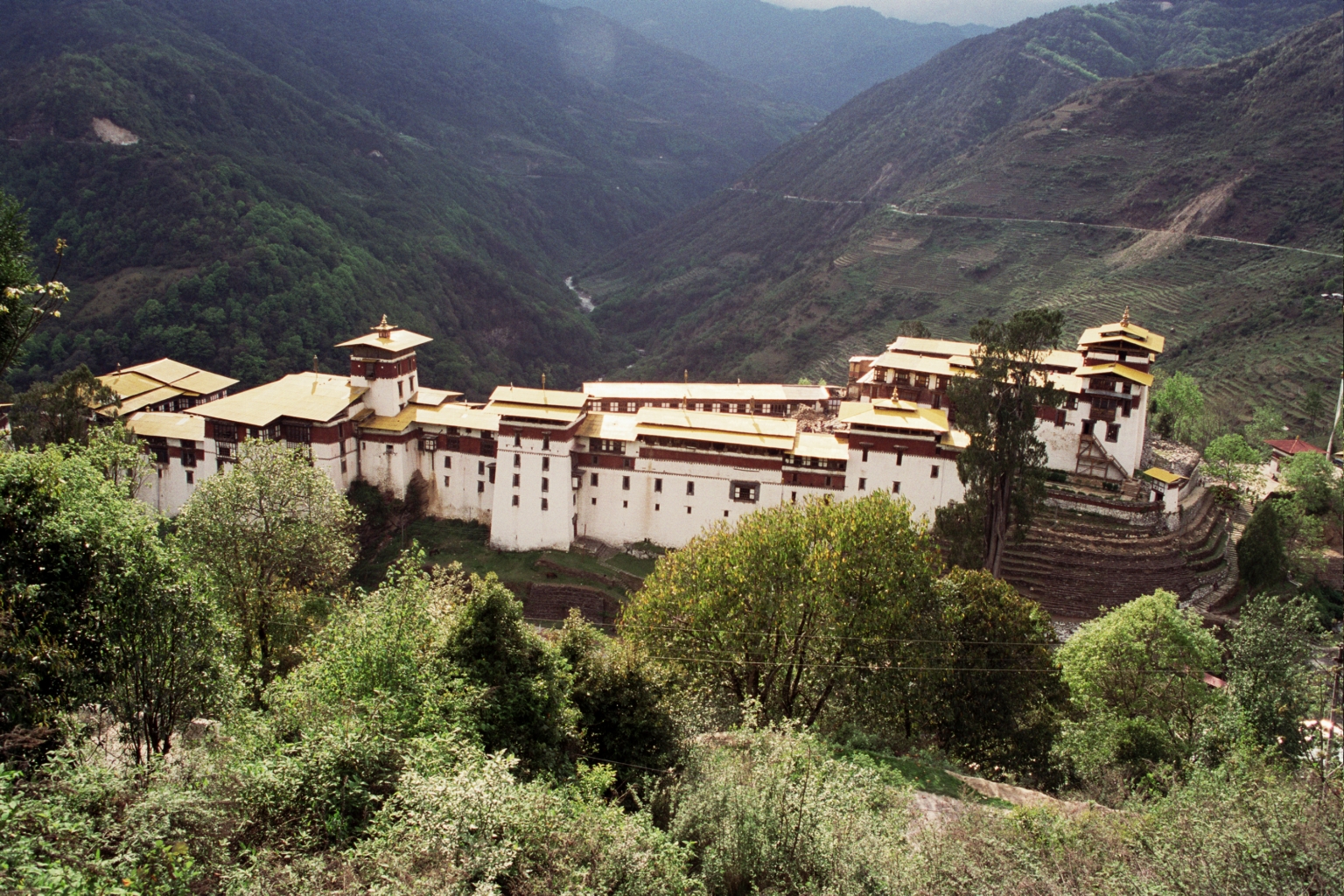 Photo: Unknown author · CC BY-SA 3.0 · Commons
Start in the round watchtower museum above town for the story of the Wangchuck penlops, then walk down to the dzong's t…
 Photo: Stephen Shephard · CC BY-SA 3.0 · Commons
Break the drive between Pele La and Trongsa at an 18th-century white stupa built in the style of Kathmandu's Boudhanath…
 Photo: Christopher J. Fynn · CC BY-SA 4.0 · Commons
The drive from Phobjikha to Trongsa crosses Pele La at 3,420 m, the boundary between western and central Bhutan, throug…
Real prices
Local prices change with season and fuel costs. Check current status before you travel.
Getting there
Air
There is no airport in Trongsa. Bathpalathang near Jakar is about 70 km east; Paro is about 320 km and two days' drive west.
Bus
Public buses on the Thimphu–Bumthang and Thimphu–eastern Bhutan routes stop in Trongsa. Tourists need their licensed guide, so most use the operator's vehicle.
Road
Phobjikha to Trongsa is about 120 km and 4–4.5 hours via Pele La. Trongsa to Jakar in Bumthang is about 68 km and 2.5–3 hours over Yotong La.
Where to stay
Trongsa has a handful of simple and mid-range hotels in and around town, several with balconies facing the dzong across the gorge. Saver doubles run about ₹2,500–4,500; comfort hotels with heating and better bathrooms cost more. There is no luxury lodge here, so signature trips usually drive through from Phobjikha to Bumthang with a long lunch stop and a dzong visit.
Trips that stop here
 Photo: Christopher J. Fynn · CC BY-SA 3.0 · Commons
Comfort
Photo: Christopher J. Fynn · CC BY-SA 3.0 · Commons
Comfort
Private car with driver
Questions
Yes, if you are driving to Bumthang. It breaks a long journey, and the dzong and Ta Dzong museum are among the most impressive in Bhutan. One night is enough for most travellers.
About 68 km, 2.5–3 hours over Yotong La at about 3,400 m. The road passes through forest and small villages. Snow can affect the pass in winter; check current status before you travel.
About 2,200 m for the town and dzong. It is lower than Phobjikha and Bumthang, so nights are milder. The passes either side are higher.
There are simple and mid-range options, many with views of the dzong. There is no luxury lodge. Book ahead in October and December, especially for the tshechu.
Trongsa must be listed on your entry permit, which your licensed operator arranges with your route. Check current status before you travel.
There is a bank in town, but card acceptance is unreliable. Carry enough cash from Thimphu or Punakha for meals, fees and small purchases.
Milder than Bumthang: roughly 0–12 °C in winter, 15–25 °C in summer with heavy monsoon rain. The gorge often fills with cloud in the morning and clears by midday.
The third king, Jigme Dorji Wangchuck, was born in 1928 in a small palace near the dzong, above the road. The Wangchuck dynasty itself rose from the Trongsa penlops.
Yes, as part of a Bumthang loop. It adds one night of SDF, hotel and guide costs. Simple hotels cost ₹2,500–4,500 a double, and local meals are cheap.
Plan with a local planner
We reply within one working day with a route, a sleeping-altitude profile and an itemised price in your tier. Change anything. Pay nothing until you are sure.